Vera Zalesskaja
The artifacts of Byzantine Cherson in their historical and cultural context
Chersonesos (referred to in this essay by its Byzantine name, Cherson) passed into the jurisdiction of the Eastern Roman (Byzantine) Empire in the 6th century A.D. Throughout the entire medieval period, this city acted as the main strategic outpost of the Byzantine Empire on the northern shores of the Black Sea. At the same time, by virtue of its favorable geographic position, it also became an important intermediary center for trade between various cities of the Greek world and the tribes occupying the territory north of the Crimean peninsula.
Late Roman Period (3rd-4th century)
In the 3rd century, the influx of Germanic tribes, beginning with the Goths, had essentially separated the peninsula from the Roman sphere of influence. The movement of these peoples from the banks of the Baltic Sea to the south-east, which initiated the centuries of large-scale population displacements commonly known as the Migration Period, brought them into conflict in the northern Black Sea region with a powerful west-bound flow of nomadic tribes from Asia. During this period, Crimea -- known to the Romans as Taurica -- underwent many changes in the ethnic composition of its population, in social practices, and in religion. As it was out of the way of the migration of barbarian tribes to the West, however, Cherson did not suffer either attacks by the Goths or Hunnic invasion. In the 4th century, Christianity was established in the northern Black Sea region with the arrival of Christians among the Greek captives taken in Asia Minor by the Goths. According to hagiographical sources, the initial stage of the Christianization of Cherson was connected with the activity of Bishop Capiton, who was sent by the Emperor Constantine the Great at the request of the inhabitants of the city. At this time three church eparchies were established on the shores of Taurica: the Bosporan eparchy, the eparchy of Cherson and the Gothic eparchy. During the first ecumenical council in Nicea (A.D. 325), the Gothic bishop Theophilus was already present; at the second ecumenical council in Constantinople (A.D. 381), the eparchy of Cherson was represented by bishop Aetherius; and bishop Longinus signed cathedral acts in 431 in Ephesus and in 451 in Constantinople.
Over the following centuries, the cultural connections of Cherson with different areas of the Mediterranean -- connections that had already been established during the period of Roman rule -- would remain strong.
Early Byzantine period (4th-7th century)
Objects from Constantinople, the Byzantine capital, occupied a prominent place among the foreign imports of this period at Cherson. These included not only practical objects and products of the metropolitan luxury industry, but also symbols of temporal and ecclesiastical power. Among the former were gold coins and official weights, such as the figural bronze balance-weight in the form of an emperor seated on a throne; the latter included objects emblematic of Christian cult. Under Justinian I (A.D. 527-565), an extensive construction program with a focus on fortresses and churches was carried out in and around Cherson. The organization of this program by the Byzantine center is visible in the use in these buildings of a large number of architectural details -- capitals, columns, bases, cornices, and chancel screens -- that were imported to the northern Black Sea region from imperial workshops on the island of Proconnesus in the Sea of Marmara, near Constantinople. It was probably around this time that a silver reliquary bearing stamps dated to late in the rule of Justinian I (around 550) was brought to Kherson . The expressive character ofthe images of Christ,the Blessed Virgin, and the archangels and saints in medallions on this work invites stylistic comparison to examples from the Syro-Palestinian group. The form and structure of the reliquary are similar to those of analogous objects found in the Balkans and in Asia Minor. Such a reliquary falls into the category of objects that were sent from the capital of the Byzantine Empire to provincial churches, in this case to the metropolis of the eparchy of Cherson, which later, in the 9th century, became one of the largest centers of missionary service for the Byzantine clergy. To Cherson were also sent special necklets serving as marks of honor, with pendant crosses and various badges and medallions, as well as with amulet mounts: a cone-shaped gold pendant is one such phylactery. Such decorations were popular in barbarian contexts because these ornaments, often acquired as diplomatic gifts, coordinated especially well with the pectoral jewelry already in style among those populations before they came into contact with the Byzantine world. When the historian Menander Protector wrote of the “cords decorated with gold” sent as gifts to the Avars in the 6th century, he had in mind such necklaces composed of coins, pendants of various forms, and mounted gems.
In the first centuries A.D., the majority of imports to the northern Black Sea region came from five areas of the Roman Empire: Asia Minor, Syria, Egypt, Attica, and the Danube provinces. These areas were of roughly equal importance in terms of the number and type of goods imported from them. Already by the early Byzantine period, however, a different balance had emerged: now imports from Syria began to dominate, and there was also a substantial increase in the quantity of goods imported from the southern coast of the Black Sea and from the former provinces of Lower Moesia and Thrace. In the 4th and 5th centuries, utilitarian items such as pottery and lamps were imported mainly from Attica, Egypt, and North Africa, but by the 6th century objects from these regions no longer reached Cherson.
Connections between Cherson and the Syro-Palestinian world -- “Syrian reminiscences in works of the artistic industry at Chersonesos”, as Protasov termed the -- revealed themselves both in the adoption of the so-called “narrative” iconography that replaced the symbolism of early Christian compositions, and in certain stylistic motifs collectively referred to as “dashed style”. These iconographic and stylistic elements were spread by various eulogiae (tokens from pilgrimage sites) brought back by pilgrims – small icons, crosses, commemorative medallions, ampullae, and lamps. It is worth mentioning, however, that these eulogiae were not always from the Holy Land: they could also be imitations, copies of Syrian examples, produced in different cities of the Empire. Both the genuine Syrian eulogiae and their imitations influenced the minor plastic arts of medieval Cherson. Thus, among the marble panels with Christian images found at the site, there is a particular group composed of reliefs with a fluted background (NPTC),which both inthe subjects represented and in the background treatment are similar to the sculptural decoration of the “Martyrion” at Seleucia Pieria, the port of Antioch (Syria), dated to the turn of the 5th-6th century. There are no stamps on the eulogia-lamp with an image of Christ and the apostles Peter and Paul, which indicates that the object did not originate in Constantinople. The strict frontal position of the figures in the medallions, the provisional manner in which the eyes are rendered, bestowing to their gaze a peculiar intensity, and the deep grooves around the faces and nimbuses, creating a strong interplay between light and dark, are especially typical of Syrian toreutics of the Early Byzantine period.
The presence of a bishop in Cherson is indicated not only by written records. Excavations in the urban area in different years have yielded the tops of four bishop’s crosiers: two of them take the form of massive bronze knobs topped with crosses, another has a silver head, and the fourth is made of bone.The examples listed,together with three crosier tops with aSyrian provenience (now in private collections in England and Germany) that are almost identical to the examples from the Hermitage, make up the only true crosier tops identified to date that can be associated with bishops of the Byzantine church. These objects are known otherwise only from images in mosaics and frescos, and thus the finds from Cherson provide unique physical evidence for such cult items.
Secular objects were also brought from Syria -- for example, a square gilded bronze niello buckle, decorated with crosses inlaid with silver. In form and design it is similar to an example from Syria held in the collection of Dumbarton Oaks, Washington D.C., which permits us to assign the same provenience to the buckle found at Cherson.
Cherson had close relations with the Byzantine provinces of Asia Minor, and particularly with the city of Sinope. The veneration of Saint Phocas of Sinope, patron of sailors, was widespread throughout the Mediterranean. John Chrysostom (between 344 and 354-407) describes the translation of the relics of this Pontic martyr to Constantinople, and the homily of the Antiochene patriarch Severus (6th century) indicates that the relics of St. Phocas were venerated in the church of the Archangel Michael in Antioch. Asterius of Amasia (6th century) writes of the spread of the cult of Phocas into the regions of the Black Sea and the Sea of Azov, “among the wild Scythians inhabiting the territory across the Black Sea, among those living in the Maeotian marsh and near the river Tanais, and also in the Bosporus and as far as Phasis”. Clay eulogia-medallions of Saint Phocas, a patron of of the almshouse of Cherson, have been found twice at the site: in 1896 and in 1963. In 2005, there appeared on the antiquities market in Vienna a glass eulogia with a similar image and inscription, which was bought by the Römisch-Germanisches Zentralmuseum in Mainz. The representation of Saint Phocas in a sailing boat with an anchor is typical for the eulogiae of this saint. He is depicted with the same attributes on a clay ampulla for holy oil with a Syrian provenience, now in the Louvre.
In 1989, in the Port Region of Cherson, there was found an eulogia-medallion with an image of Saint Longinus the Centurion, who later became the first bishop of Cappadocia. The saint is represented wearing military dress and standing between two schematically-rendered cypresses; along the edge of the medallion is preserved part of a Greek inscription reading “Eulogia of Saint Longinus Crenaeus”. This saint was venerated in several centers in Syria and Asia Minor.In Trebizond there is a church dedicated to him, which in written records is called St. Longinus’ church near “the spring” (ἁγίουΛογγίνουτοῦΚρηναίου), from which the epithet “Crenaeus” is derived. Apparently, commemorative medallions with the image of Saint Longinus Crenaeus were produced in church workshops near this spring. This find from Cherson represents a new type of eulogia, previously unknown, with a unique iconography representing the military saint Longinus holding a cross-shaped spear, like those of first martyrs. On the basis of the saint’s epithet, we can conclude that such eulogiae were produced in Trebizond, and thus that Cherson already had connections with this city before the Iconoclastic period. A fragment of a bronze candelabrum with a sculpted figure of a horseman can be related to Anatolian workshops. The iconography of the figure is derived from the depiction of “Christ and the Four Horsemen of the Apocalypse” in a composition from Ephesus, and from pilgrims’ ampullae with scenes of the Second Coming and the heavenly host, which were widespread throughout the Empire.
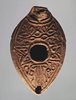
Imports from the Danubian provinces (Lower Moesia and Dacia) and from Thrace were commonplace in Taurica in the first centuries AD. They were especially noticeable in places where there were Roman garrisons – in Tyras, Olbia and Chersonesos. Most common among these imports were utilitarian objects, religious items connected with the cults that were widespread among Roman legionaries, and ornaments associated with military gear. Connections with the provinces along the west coast of the Black Sea and the Danubian frontier continued during the period of the Gothic and Hunnic invasions. Rather widespread in Cherson are lamps with relief hatching radiating out from the fill-hole like a fan. This motif of spreading rays -- a symbolic representation of the rays of light emanating from the lamp -- is typical of lamps found in several cities of Lower Moesia: Kalatis (Mangalia), Tyras, and Iatrus. The lamps from Cherson are closest typologically to Bulgarian and Romanian examples. These lamps, made from the same clay typical of local pottery, are considered to be products of Chersonesan workshops imitating Danubian prototypes. Local variants include lamps of the 4th-5th centuries bearing the Greek letters ΧΡΥ stamped in relief on the discus, surrounded by rays. In the 6th century, piriform lamps with a discus decorated with radiating lines and a heart-shaped relief border around the fill-hole were widespread at Cherson; their handles take the form of a cross or a leaf. Although such lamps are found in various cities of the Byzantine Empire, the majority have been found in Bulgaria, particularly in Odessos (Varna), which suggests that they were a local product of that area.
With the “barbarian” cultures of the Eurasian steppe, on the other hand, can be associated a number of finds from Cherson, including cicada brooches, belt plates, and buckles decorated with the heads of birds and fish, and characterized by beak-shaped tongues and abundant inlays of gemstones and glass paste. Cicada brooches, dated to the 5th-6th centuries, were widespread among the Gepidic tribes.As for Byzantine belt sets or belt sets made according to Byzantine patterns, an analysis of their design shows relations between the inhabitants of Crimea and Khazar craftsmen, specifically during the period when Great Bulgaria (Onoguria) seems to have been included in the second Turkic khaganate. Even though these sets were made in Byzantium proper as gifts for Byzantine foederati, their decoration reflects barbarian styles. Constantinopolitan goldsmiths took into account the tastes of their consumers when they created jewelry for the rulers of the northern Black Sea region, where the artistic traditions of the “Hunnic period” still survived, and employed techniques developed by artisans working in the polychrome, or “Bosporan”, style.
Attic imports in 4th-century Chersonesos are represented only by lamps. These lamps include a typical Attic type, on the discus of which is a stamped image of two fish hanging together from a cord. These lamps were made in the workshops of the Athenian Kerameikos as early as the 3rd century A.D., and the latest examples are dated to the 6th century. The composition is perhaps connected with the cult of the Iranian earth-goddess Anahita, as there are several known images of this goddess holding a fish in each hand. One cannot exclude, however, that the Attic lamps fall into a genre of bucolic art that was rather widespread in Late Antiquity, in which various outdoor past-times or the pleasures of the outdoors in general played an important role. In any case, there is no direct evidence for the interpretation of these fish on the discuses of Attic lamps as Christian symbols.
It must be noted that in the Early Byzantine period, Greek imports to the northern Black Sea region declined markedly in comparison with the first centuries A.D. Imports from the Aegean now consisted not of product lines, but of individual items. One can observe a similar pattern in the importation of North African material, most characteristically represented by red-slipped pottery with stamped decoration. This pottery is conventionally connected to the so-called “African type”, although not all such objects have obvious connections with this region – they were widespread all over the Eastern Mediterranean. The general term “African” refers more to a general typological class than to local characteristics. Finds of red-slipped vessels, most often fragments of bases and walls, are common in Early Byzantine layers at Cherson. On them are found images of animals, birds, and sometimes human figures, but the most frequent decoration consists of stamped Christograms and crosses. A square tray found at Cherson, dated to the turn of the 4th-5th century and bearing a scene of a circus hunt, can be assigned to this category of pottery. Under the influence of an increasingly established Christianity, the motifs of the hunt and of gladiatorial combat with predatory animals came to symbolize the triumph of good over evil in the philosophical constructs of early Byzantine authors. These Byzantine philosophers had their ideological predecessors. As early as the 2nd century A.D, the Roman author Dio Chrysostom described the hunt as a school of courage and valour in his works. In accordance with this formulation, the victory of the hero-hunter came to be seen as a triumph over death, over evil and temptation. For this reason, such motifs, together with many other ancient representations of the “heroic hunt”, were received by Byzantine art as a substantial component of the imperial triumphal cycle and as a model for the education of a monarch who would be both strong and magnanimous.
To the same “African type” belongs a plate with an image of Christ surrounded by three birds; these birds allegorically indicate the presence of the triune God. The rendering of Christ’s hair and dress is typical of representations of human figures on red-slipped stamped pottery, and a cross-staff in Christ’s hands is identical to stamped gemmed crosses on lamps and vessels of North-African type. The latter are dated within the arc of the 6th century. The iconographic type of Christ on this plate, which differs from other types in the absence of a nimbus and in the presence of the large cross of almost human height that he holds in his left hand, appeared in the 4th century and developed over the course of the 6th. Fragments of two plates with a similar subject, now in the State Hermitage, originate from Coptic Egypt. One of them was found in Sohag (Upper Egypt).
Connections between Cherson and Egypt in the Early Byzantine period were as sporadic as connections with Greece and North Africa, and they too are represented only by individual artifacts. While during the Roman period almost the entire pantheon of Greco-Egyptian gods – Serapis, Isis, Harpocrates, Zeus Ammon, Anubis – was represented in finds from the Black Sea region, connections with Christian Coptic Egypt are represented only by a clay ampulla with a traditional image of Saint Menas between two camels. Ampullae of Saint Menas were very widely distributed: they were found not only throughout the eastern and western Mediterranean, but also in Central Asia, Gaul, and Britain. Certain magical phrases and magical symbols of life, found for instance on clay ampullae and on lamps decorated with the so-called “Egyptian knot of life”, are sometimes also associated with Egypt. Neither the phrases nor the symbols are in fact connected with Egypt. The magical formulae have a syncretic character and are distributed throughout the entire Empire. The lamps, most of which were found in the northern Black Sea region and only a few of which come from Asia Minor (Miletus) and Egypt (Antinous), have on their discuses a stamped motif identified by scholars as a “mystical well” or a “fountain of life”. This motif combines the iconographic features of the Holy Sepulcher and those of a baptistery. These lamps seem to have been produced somewhere in the Pontic region, and the possibility of production centers in the northern Black Sea region cannot be excluded
Thus, Early Byzantine Cherson maintained contacts with the same regions of the Mediterranean with which it had been connected in the first centuries A.D. New relationships and changes in the intensity of trade were brought about by the particular political and social factors that, between the 4th and the 7th centuries, determined the history of the region as a whole: the foundation of Constantinople, the beginning of the Migration Period, the adoption of Christianity.
Traditional relationships between the Danubian provinces and the northern Black Sea region in this period led to the formation of a single cultural space characterized by uniform sets of grave goods, decorations, and household objects. There is practically no significant difference between the finds from Cherson and material from Intercisa (Hungary), Iatrus and Nicopolis on the Danube (Bulgaria), Ulmetii (Rumania) or Tsaritsyn Grad (Serbia). This was a single world in which predominated certain types of objects and methods of decoration that had developed during the Migration Period.
In the northern Black Sea region, two important aspects of the political and cultural life of early Byzantium came together: a missionary enterprise involving a vast area, and the “Bosporan element” as an artistic phenomenon. By means of Christian missionaries, Constantinople strove to extend its influence to such political entities as Khan Kubrat’s Great Bulgaria, the Khazarian khaganate, and the Rus’ state on the Dnieper. The Bosporan style was manifested in a particular type of decoration applied to stamped gold and silver articles (such as belt buckles and fibulae), involving the use of semi-precious stones and colored glass and glass-pastes. This jewelry style, which was originally connected to the Crimean Bosporus -- ancient Panticapaeum -- spread during the Migration Period from the steppes of the northern Black Sea region to Merovingian France, where these ornamental techniques found popularity and a rather long new life. A number of the visual elements and technical features associated with this style were adopted by Byzantine artisans. When a considerable quantity of jewelry had to be produced, for example, to be distributed as gifts, such runs of items were executed in the “Bosporan style”.
The Period of Iconoclasm (726-787, 813-843), which, in the sphere of culture, was characterized by two retrospective tendencies -- an interest in antiquity and the wish to return to early Christian aniconic art -- left no significant monuments. Remains of this period are also absent in Cherson, with the exception of a fresco of uncertain date from the “1935 Basilica”, household pottery associated with the “Saltov-Mayatskoe culture”, and white-clay painted mugs and chalice-shaped cups. These vessels began to be regularly included in Christian liturgy at the time of the missionary work of Saints Cyril and Methodius. As a result of the activity of the orthodox clergy who fled to Taurica from iconoclastic Byzantium, Cherson played an important role in the fate of the Greek Church and of Byzantine culture at the periphery of the Empire. This is reported in the 92nd epistle of Theodore Studites (first half of the 9th century): “The saving hand of God organized this exile not only for the sake of their salvation, but also for the salvation of the local inhabitants. They appeared there [in Cherson and its vicinity. – V.Z.] as lamps called to shine in the darkness and error of life, as guides for the blind, as teachers of virtue, as preachers of piety."In the late 860s or early 870s, Saint Cyril himself, on his way to Khazaria, visited Cherson.
A renewed influx of Byzantine imports to the Black Sea coast can be connected with the general recovery of trade in the second half of of the 9th century, which is indicated by the eulogy to Saint Hyacinth of Amastris written by Nicetas of Paphlagonia. The way from Constantinople to Cherson ran along the northern coast of Asia Minor to Sinope, and then it crossed the Black Sea.
The second half of the 9th to the 12th century
For Byzantium, this period was marked by the flowering of the jeweler’s craft, toreutics, stone and bone carving, glassmaking, ceramic production, and the textile industry. For the number of objects that have survived and for their technical and artistic excellence, this period has no equal. Constantinople continued to play the leading role in all areas of artistic production, and the works of metropolitan craftsmen continued to be the models for the Empire’s neighbors both near and far. Some examples of this art have been found at Cherson: icons made of bronze, stone and bone, and jewelry produced by metropolitan craftsmen or by those who had been trained in the capital. The most refined work, the work most in tune with the aesthetic principles of Byzantine art, was the product of the genius of the enamellers. Cloisonnéwork, unrivaled in technical excellence -- with its refined linear stylization, the depth and purity of its local colors, the golden net encircling the smallest details of the picture -- produced an impression of the weightlessness of figures and the irreality of space. The enamellers of the 10th century added violet and yellow, light blue and turquoise colors to the palette of green, dark blue, purple and red that dominated in the Early Byzantine period. An abundance of gold highlighted the spark of divine energy and symbolized triumphant faith: these intensely spiritualized images reflected the prevailing climate of heightened spirituality. On the northern shore of the city-site, in strata of the 9th-10th century, two examples of such gold cloisonné work were found: an oval medallion with the image of a bird and an archedplaque on which are representedpeacocksflanking a vessel .Both of these finds are unique not only for Cherson:cloisonné items of such an early date are also extremely rare in the rest of the Byzantine world. A two-sided bronze quatrefoil pendant bearing an image of Christ’s head on one side and an image of an unidentified person wearing a crown on the other side is decorated in a champlevé enamel technique. This enamel technique is not typical for articles produced within the Byzantine Empire itself. In the high Middle Ages, this type of decoration was widespread primarily in the Latin West – along the Rhine, in Lorraine and Limoges. Byzantine articles with champlevé enamel on bronze are dated to the time of Crusades, that is, to a period when Western influence on Byzantium was especially great. Enamel colors were also used for glass painting. Some glass vessels found at Cherson were decorated in this manner. The ability to combine gold painting with enamel was considered one of the glassworker’s greatest achievements. This method first appeared in the 10th century among Syrian artisans. By the 11th-12th century, vessels decorated in this manner were already connected mainly with Byzantium.
Byzantine toreutics are represented at Cherson by isolated but original objects, which, although they aspire to imperial models, do not copy them precisely. These represent examples of provincial art. Such items include a silver chalice of the 9th century with a traditional eucharistic inscription and crosses in medallions, which perhaps belonged to Constantine, archbishop of Cherson; a gilded bronze Middle Byzantine diptych bearing embossed crosses between spiral colonnettes; and a silver cross-shaped appliqué of the same period that served to decorate a book-cover. In 1890, a bronze pectoral reliquary cross (encolpion) was found on the acropolis of Cherson. On this cross, a scene of the Ascension with the Virgin Nikopoia at the center and a scene of the Transfiguration, rendered with silver inlay and niello, follow iconographical patterns conventional for the 10th and 11th centuries.
Bronze icons were found during excavations in the city in various years. As in the metropolis itself, they were of two types: massive cast-bronze icons finished with embossing and engraving, like a gilded icon of the 12th century with an image of the Virgin and Child,or an icon of the 11th century with a Deesis composition; and icons made of thin bronze sheet. Most examples of the latter type were found at Cherson. Among them are such well-known items as the icon with images of Saints Cyrus, Lucilian and Ioannicius,or the icon representing Archangel Michael of Chonai and a donor named John. According toa partially preserved Greek inscription, an icon with a shoulder-length image of Christ Pantokrator is so a votive object. The fine rendering of Christ’s face, which gives a sense of volume, is particularly notable. The character of the modeling, like that of the icons from the Chersonesos Museum, recalls the classicizing aspirations of Byzantine craftsmen of the 10th century, although features of the more spiritual style of the following century are evident in the rendering of the images. The general linear stylization of form, which would become so typical of the art of the Comnenian period (1081-1185), is emerging here. The icon with the image of Christ Pantokrator was probably made in the second half of the 11th century; this date is suggested by iconographic details such as the five convex dots, symbolizing Christ’s wounds, on the arms of the cross in the nimbus. A connection between the emphasis placed on this highly “passional” symbol in the 11th century and the influence of the theologian and mystic Symeon the New Theologian (949-1022) cannot be ruled out. Such icons were attached to wooden backings. We shall use for them the term σαρούτια (derived from σάρουξ, “copper”), which is used to designate bronze icons in the Typicon of Gregory Pakourianos, in the inventory of Monastery of Patmos, and in the Testament of Cappadocian magnate Eustathius Boilas (1059). The latter dignitary ordered that a church be built in the name of the Blessed Virgin in one of his estates, known as Salim, in the Antiochene theme, and he contributed to it twelve bronze icons. Our knowledge of artistic metalwork at Cherson does not permit us to identify the icons found at the site as products of its own workshops; it is most likely that they were made in the same center that produced the icons donated by Eustathius Boilas, and thus we are dealing with works produced by Greeks in Asia Minor. Conventionally, cast bronze icons with high-relief images are associated with Constantinopolitan production, while icons made of thin sheet of bronze are connected more broadly with Byzantine Asia Minor.
Examples of bronze casting and embossing found at Cherson are important not only as works of art, but also as indications of the city’s broad range of trading connections. Processional crosses and reliquary crosses with embossed and engraved images were brought there from the Syro-Palestinian region; a lead ampulla with an Arabic inscription was made in Palestine in the Crusader period; zoomorphic bronze locks in the form of various animals are associated withthe Volga Bulgars; and the figure of a nomad on a fragment of a bronze candelabrum may have been inspired by the world of the Turkic tribes that moved by turns through the steppes of the northern Black Sea region on their way to the West. Scabbard-ends with relief images of birds and stylized floral decoration come from Scandinavia. The presence of a “Russian Quarter” in Cherson explains finds like spindle-whorls of Ovruch slate and Slavic utilitarian pottery, as well as the presence of the main types of Rus’ reliquary crosses, including those bearing images of Saints Boris and Gleb.
Icons, crosses and holy images carved from steatite are frequent finds at Cherson. In Byzantine sources, this material is called “spotted stone” or serpentine. Steatite objects are also mentioned in the poems of Manuel Philes (1275-ca. 1345). Steatite icons with images of soldiers, and especially with George and Demetrius, are commonly thought to date to the 11th and 12th centuries, since military subjects were especially popular in the Middle Byzantine period. The image of Saint Demetrius on the icon from the Hermitage, where he appears together with Saint George, is almost identicalto the image of the same sainton the bottom of the serpentine bowl from the treasury of the cathedral of Saint Mark in Venice. Both objects show not only the same iconographic type, but also the same set of minor details and technical characteristics, for example in the rendering of hair and clothing. The production of these objects can be connected with Byzantine centers such as Thessaloniki, and is characteristic of the high level of the art of stone-carving in this city, the patron saint of which was Saint Demetrius himself. The production sites of Byzantine steatite articles are not yet fully understood, and arguments for provenience can be proposed only in the case of eulogiae from specific piligrimage sites. Such an argument allows us to presume that the small icon with a cross and rosette comes from Asia Minor. On its face, around the cross, are placed eight hollows of varying configurations. It is possible that these hollows refer to one of the numerous rock-cut churches of Cappadocia. Small niches cut in the bedrock in its interior could have set the pattern for a stone-carver producing eulogiae. Such objects would have been intended to remind pilgrims of the cave-churches they had visited.
A considerable number of objects made of carved bone have been found in the urban area of Cherson; the bone used is typically that of domestic animals, although articles made of elephant ivory have also been found. Bone was used for the production of miniature icons and portable diptyches and triptychs for home churches; it also served as decoration for caskets in both secular and religious contexts, and in a few cases for funeral clothes. The majority of the objects were painted. Square, trapezoidal, triangular, and round plaques with images of animals were used to decorate caskets. A casket bearing images of animal combats and predators attacking centaurs,the plaques of which are carved fromthe bones of domestic animals,can be considered the work of local bone-carvers, as can a number of other individual plaques. A bone icon with a depiction of Luke the Evangelist also served as decoration for a casket on the walls of which, if one can judge from analogies, images of the twelve apostles were placed. Such caskets were often used as reliquaries. The uniqueness of the plaque from the Hermitage lies in the fact that it was carved from a horse’s hoof, which suggest that the casket to which the icon of Luke was attached was itself made in Cherson. Another rectangular plate with a depiction of a seated soldier with a sword on his lap and a spear in his right hand was probably also carved locally. To judge by similar images on lead seals, King David is represented here. An ivory plaque with a depiction of Saint Demetrius in the guise of a martyr, which served as a side leaf of a miniature triptych ,was probablybrought to Cherson fromThessaloniki, like the steatite icon of Saints George and Demetrius.
The applied art of Byzantium developed on several different levels, which in turn reflected different intellectual orientations. The manufacture of handicrafts for a broad market led to the flowering of an art oriented toward folk culture, with its own aesthetics. The art of the city potters reflected the influence of the images produced by metalworkers. This vernacular style in art is represented by the bright and colorful glazed pottery used in everyday life. In the 9th and 10th centuries, white-clay pottery covered with monochrome green or yellow-brown glaze and bearing stamped relief decoration was most prevalent. It was produced in several centers, as yet unidentified, from where it was delivered to the Byzantine cities of the Eastern Mediterranean and the Black Sea region. This pottery is also widely represented in Cherson. From the area of Constantinople come dishes with designs in the form of rosettes and stars, or with depictions of eagles, griffin and peacocks, symbols of resurrection and immorality, flanking representations of “the tree of life”. Also common are images of animals and birds and scenes of predation -- for example, a griffin rending a fallow deer. In the 9th century, a painted white-clay pottery appeared, on which the painting consisted of mineral pigments applied directly to the ceramic fabric: the black-brown outline of the image was applied with a brush and the details were accented with a thin wash of brown, yellow and pink paints, while dark blue, green and red pigments could be applied as a paste so thick that it formed a sort of relief. Vessels were covered with an over-coat of transparent glaze, through which the colors of the painting were visible. The area of distribution of this pottery is not large, and neither is the number of finds, most of which come from Cherson. The rich archaeological assemblage found in 1976 in the fill of a fish-salting cistern included several dozen fragments of Byzantine white-clay glazed pottery of the 10th century. These fragments belong to fourteen different vessels. The dish with floral designs in four medallions is one of them. Two of the medallions are filled with a design in the form of a stylized tree with a double lowered crown; the other two are filled with palmettes, the branches of which are composed of inward-curving half-palmettes. The background consists of scattered red dots. A similar design is found in miniatures in Byzantine manuscripts of the 10th century, but it is also present on artifacts of Iranian origin. The Hermitage dish is akin to Abbasid pottery in its background of red dots, and also in the decoration of the rim of the dish with a wavy line composed of semicircles. The process by which Greek artisans manufactured elegant painted vessels is reflected in the famous work De diversis artibus (“On the various arts”) by Theophilus Presbyter (the pseudonym of the artisan Roger of Helmarshausen.
In 10th-century Byzantium, white-clay polychrome tiles meant for the decoration of walls and chancel screens became popular. Among them a group of ceramic icons stand out. These are found in substantial quantities both in Constantinople and in Preslav, the ancient capital of Bulgaria, and its environs. In 1892, in the eastern area of the urban center of Cherson, on the seashore, as a part of a whole assemblage of liturgical objects, was found a ceramic icon with a depiction of Saint Elizabeth Orans, with her arms raised in prayer. According to tradition, Saint Elizabeth was the mother superior of a convent of Saints Cosmas and Damian, founded in Constantinople under Justinian I; in later times, her relics were to be found there. Information on the shrine of Saint Elizabeth is provided to us by the Russian pilgrims Stephen Novgorodets and Zosimos. Saint Elizabeth was venerated as a healing saint in the Balkans. The sketchy and somewhat careless manner of this icon, the vague brown outlines of the image, the arrangement of the decorative field, and the icon’s size recall examples from Preslav. The absence of elements of the refined style that marks Constantinopolitan icons gives reason to suppose that this icon of Saint Elizabeth may belong to the Preslav group, in which case it could have been be brought to the Northern Black Sea region by one of the pilgrims who visited Great Preslav. Such portable ceramic icons served as pilgrim tokens or eulogiae, in connection with the worship of the Mandylion of Edessa and of the Keramion, or “Holy Tile” – the first ceramic icon, created by divine rather than human forces.
New ceramic types appeared in the 12th century: painted white-clay pottery with green-brown painting without outlines and red-clay pottery covered with a white engobe into which images and decoration were incised (the sgraffito technique) or rendered by scraping away parts of the background (the champlevé technique). All these types of pottery are represented in plenty at Cherson. On white-clay jugs, plates, and cups with free painting, real and fantastical animals and birds arerepresented, as well as purely ornamental compositions. In Constantinople, such pottery is dated by the contexts in which it is found to the second half of the 12th-early 13th century.Vessels decorated in the sgraffito technique are widely represented among the finds from the area in Constantinople where once were situated the Baths of Zeuxippus, which have given their name to this ware in general. Such vessels have also been found in other areas of the Byzantine capital, as well as in Thessaloniki. The wreck of a Byzantine ship loaded with pottery, among which were 32 dishes of Zeuxippus type, was found by underwater archaeologists near Alonnisos near the islands of Northern Sporades.At Cherson, pottery decorated in the sgraffito technique shows similarities in design principles and ornamental motifs that connect it to a ceramic koiné shared by the entire eastern Mediterranean-Black Sea area. Despite all the variations in ornamentation and the particularities of the manner of individual potters, the vessels found at Cherson have characteristics in common with pottery coming from other parts of the Byzantine Empire. This pottery arrived in the northern Black Sea region from the metropolis: Venetian and Genoese merchants, who gained strength during the period of the Crusades, played an important role in its delivery.
The images of warriors and griffins, the scenes of combat, and the ornamental compositions on these vessels are rendered by incision into a coat of engobe; the incised lines are dark brown, with light brushstrokes of manganese to highlight the main outlines. The drafting is fully conceived and precisely finished; it is characterized by a finesse in execution and even a certain artistry. It features a fluid line drawn with a sure and virtuosic touch, in which the hand of a master can be sensed, probably an experienced artisan who frequently created similar images. The general tonality, taking into account the color of the glaze, is brownish-yellow or brownish-green. On plates bearing images rendered with incised lines, two types of representations can be seen: portraits in medallions and battle scenes.Both types are usually dated by archaeological context to the late 11th and 12th centuries, and are related to objects of the “metropolitan school”, in the broadest sense, which included not only Constantinople itself but also the production centers of the north-west part of Asia Minor -- that small territory remaining within the borders of Byzantium after the defeat at Manzikert (1071) and the foundation of the Seljuk state. Under the emperor Manuel I Comnenus (1142-1180), Pergamon became the capital of Neocastra, the military-administrative district bordering Seljuk territory, and at the same time it emerged as a major center for the production and export of glazed pottery.
The use of images in medallions stretches back to the Hellenistic tradition of decorating cups with allegorical figures of virtues, which together with hunting scenes symbolized the triumph of good over evil. In 1955, a ceramic dish bearing the depiction of a warrior fighting a fantastical animal was found at Cherson; this warrior has sometimes been identified with the hero of Byzantine epic Digenis Akritas. Warriors fighting with predatory animals or, like Saint George, slaying dragons or serpents, represented epic heroes. It is possible to identify direct connections with the deeds of the legendary Digenis Akritas. But at the same time it is accurate to see in these depictions a synthetic representation of figures who defend one from enemies and protect against malign forces.
13th-14th centuries
As the result of the occupation of Constantinople by Crusaders in 1204 and the foundation of the Latin empire (1204-1261), Byzantium as a unified state ceased to exist for more than half a century. The development of new historical realities in the Eastern Mediterranean changed Cherson’s situation as well. The city expanded and strengthened its relations with the Seljuks who controlled much of Asia Minor, where they founded the state of Seljuk Rum, with its capital first at Nicomedia and later at Konya. At the end of the first quarter of the 13th century, the Tatar horde of Genghis Khan invaded Taurica. In 1238, 1242 and 1249, Cherson was subject to raids by the inhabitants of the steppes. In 1299 the hordes of Nogai delivered a fatal blow to Cherson, after which the city could not recover. At the very end of the 14th century, when in 1399 Tatar hordes made a devastating raid into western Crimea, life in the city ended for good. From the 13th century on, a larger role was played in Taurica by Italians, especially by the Genoese, whose city-states included Cherson among their fortified outposts stretching from the Sea of Azov to the Mediterranean. Traditional trade routes changed as a result of the economic activities of Venetian and Genoese merchants, and this in turn made Cherson dependent on the Trebizondian empire of the Comneni on the south-eastern coast of the Black Sea. By the 15th century, the political existence of both eastern and western Byzantine realms had been ended by the Ottoman Turks, who arose in the eastern part of Asia Minor and captured Constantinople in 1453. With these cardinal changes in the economic and political organization of the region, Cherson ceased to be a transit center for trade, the Genoese left their establishments in Crimea, and the Tatars declared themselves Turkish vassals.
In the 13th and 14th centuries, as a result of political and economic instability and the impoverishment of Byzantium under the Palaeologi, the production in the empire of articles made of precious metals, cloisonné enamel, ivory, and gemstones decreased sharply. Bronze and ceramic vessels superseded those of gold and silver, and carved wood took the place of ivory. In the last centuries of the existence of the Byzantine Empire, ceramics took a lead role in the typical culture of all levels of the population in all its regions, including Taurica. Glazed vessels were decorated by means of various techniques: along with images rendered with deep incised lines (sgraffito), the champlevé technique was also employed; inscriptions and some details of the figures were added with slip-painting. On white-clay vessels the figures of animals and birds were painted with blue, red-brown, and green pigments; many cups bore the monograms of their owners, which took the place of images or, enclosed in medallions, themselves became decorative elements. Late Byzantine ceramic production has been documented in various parts of the Balkans: in Attica, Macedonia, Moesia, and Thrace. The Anatolian cities of Nicea and Nicomedia maintained their position as developed pottery-production centers. In Corinth, Thebes and Sparta, large red-clay dishes with incised images of fish, lambs, and grape-vines beneath a yellow over-glaze were widespread. The use of early Christian subjects (lambs, fish) is one of the characteristic features of the culture of the Palaeologan renaissance. This group of pottery has two distinctive features: its images belong to a new current of exploration in Byzantine art, which in itself points to developments in the metropolis, while the character of the stylization of the grape-vines reveals the influence of the Arabic Naskh script. Of the original areas of the empire, it is largely Greece where objects with these features, with their marked orientation toward the Islamic East, become common. The source of this influence was, on the one hand, the occupation of the island of Crete by the Byzantines in 960 and the ensuing migration of Muslims to Attica, and on the other hand the intermediary role of the Greek trade centers that received objects imported from the Islamic world. During excavations in Thessaloniki, Olynthus, and Pella, and also in south-western Bulgaria, red-clay vessels with sgraffito images representing dragon-slayers were found. Others bore the images of certain saints, for example Saints George and Demetrius, accompanied by inscribed monograms. Although the compositions on these vessels are similar to those of contemporary Cypriot pottery, the character of the drafting and the iconography mirror images on Byzantine coins minted in Thessaloniki under the emperor Andronicus II Palaeologus (1282-1328). A bowl with a magical hexagon, known as the “Solomon’s Knot” or “Shield of David”, surrounded with circles and lotus flowers, can be connected with examples of the Seljuk art of Anatolia. The decoration of the inside of this vessel is rendered with lines incised into a layer of engobe, in combination with gouging and the champlevé technique; the external surface bears decorations painted in white engobe. The style of such cups shows features of the early Mongol period, characterized by a significant influx of eastern elements, which can be found in many ceramic assemblages of 13th-century Cherson. The decoration of this vessel has analogies in the miniature art of the 13th century, while similar lotuses decorate a dish found near Amasia (Asia Minor), a typical example of Anatolian pottery. The eastern wave that came from Asia Minor, with numerous motifs borrowed from the repertoire of Iranian potters, in the early 13th century reached its highest level of expression in an extensive group of polychrome pottery with red fabric and with decoration incised into a layer of engobe. Vessels produced in Iran itself also made their way to Cherson, for example a fragment perhaps originating in Ray with a depiction of a figure wearing a light-blue and green headdress. An aquamanile in the form of a bird’s body on three feet/supports, with a handle,was probably made in Cherson itself,in imitation of eastern hand-washing devices. On the head of this bird there are two holes: one hole for filling the vessel with water, and the other, at the beak, for pouring the water out. The aquamanile was found with several coins: two Seljuk coins of 1204 and 1210, and one Nicene coin minted under the emperor John III Vatatzes (1222-1254).
A thin-walled icon lamp of well-levigated clay, with a rounded bottom and three decorative suspension loops, comes from a medieval house in use in the 13th-14th century. Its form imitates Byzantine icon lamps of metal and glass.
Limestone reliefs made at Cherson and used for various purposes also show the influence of the Seljuk art of Asia Minor.
From the same areas of eastern Asia Minor, from the Empire of Nicaea (1205-1261) and from Armenia, ornamental bronze objects were brought to Cherson. Among them there is a one-sided reliquary cross with an image of Saint Photius rendered with engraving and silver inlay. It wasfound during excavations ofa medieval residential complex destroyed in the course of a conflagration that took place during the first half of the 13th century. In his left hand the saint holds a small bundle, probably an akakia, symbolizing the futility of mortal life. The akakia was normally an attribute of Byzantine emperors, but Saints Stephen and John the Theologian were also depicted with this object. In his right hand Saint Photius holds a thurible. The character of the stylization of the saint’s clothes is different from that on crosses of the Syro-Palestinian type. It appears that we are dealing with a workshop that produced eulogiae connected with the cult of a local saint. A martyrium of Saint Photius is known to have been located in Nicomedia. It was considerably renovated in the early 13th century, when, at the command of the Nicene emperor John III Vatatzes, the monastery of Saint Photius was rebuilt and expanded. A coin of this emperor was found in the same residential complex as the reliquary cross.
Octahedral mortars of cast bronze, decorated with engraving and red copper inlay, are imports from Asia Minor. On seven of the facets of the Hermitage mortar, inlaid with red copper, there are almond-shaped projections and engraved arches, while the eighth facet is occupied by a handle in the form of a bull’s head. The motif of the bull’s head is known in the Seljuk art of Anatolia and was widespread in Armenian architecture, especially in the 13th century, as an element in the crests of Armenian princes. One of two mortars in the Chersonesos museum bears an Arabic inscription. It is generally thought that such objects were produced in Armenia.
Connections with the medieval West are marked in Cheson by the discovery of a bronze bowl made in Western Europe, bearing Latin inscriptions and engraved images of virtues and vices, and by objects that imitate imported western prototypes. Among. The stem ofcandlestick is very short andresembles more closelythe prickets of Byzantine chandeliers. Candlesticks with such cups are unknown among objects of Byzantine production. Flat-bottomed cups for wax in the form of an intersecting quatrefoil and square, with knobs or “buttons” on the projecting vertices of the square, are typical of romanesque items of the 12th and 13th centuries, probably produced in Lorraine. We can assume that this candlestick was produced by a local artisan working in Asia Minor or in Cherson itself, who had in front of him a model from Lorraine, borrowed the form of its base, and then connected it with the pricket typical of Byzantine chandeliers. Objects imported from the West usually arrived in the Black Sea region after passing along the Danube. However, in the period of the Crusades, in addition to this famous route, one might also envision another route running through Asia Minor, the western part of which was occupied by Crusaders during the First Crusade and was used by western knights in their advance to the south and south-east.
The “Russian Quarter” in the northern region of Cherson is represented not only by examples of cast bronze and pottery of Middle Byzantine period. There are also finds dating to the 13th century. Among them there is a bronze patriarchal cross with images of the Crucifixion and onlookers, the apostles Peter and Paul, and the archangels Michael and Gabriel. Under the Crucifixion there is a full-length figure holding a scroll and framed with a vertical inscription that identifies him as Lazarus.
At Late Byzantine Cheron, in addition to objects that can be traced confidently to known production centers, there was also a substantial quantity of various glazed ceramic and bronze objects of types that were widely distributed across the entire empire. They include chandeliers andthuribles or censers. Some censers have round or ellipsoid handles with decoration both typical of that period and unique to that object. Thus, on the handle of a censer found in a medieval house of the 13th-14th century, the images of two birds with twisted necks are rendered with moulding and chasing against floral decoration and hatching. Similar censers were frequently found in the Balkans: in Greece, at Mystras and Meteora; in the South Slavic countries, in Bulgaria and Serbia. They come from Veliko Tarnovo and Yanievo, as well as from the Prilep area, and a number of examples are stored in the Markov monastery (Serbia). A censer with the image of the Virgin Therapiotissa, dated to 1300, now at the Benaki museum in Athens, came from the area of Constantinople (near Therapia). All these objects were cast during a limited period of time, from the late 13th to the 15th century. Balkan censers, to which the censer with birds from Cherson is related by its stylistic and iconographic elements, have a similar form and size, but they differ in the decoration of their modeled handles. The handles of the Balkan examples have rather complex ornamentation. Interlacing floral and geometric motifs frame highly stylized, sometimes even transformed, early Christian symbols: pairs of birds representing the immortality of the soul (as on the censer from the Hermitage), the tree of life, dolphins. At the same time, the character of the execution of these motifs reveals strong western influences, specifically the penetration and reception of Late Gothic art. According to written sources, censers were used during the funeral liturgy and at services during the last three days of the Holy Week. These censers were often depicted in frescoes of Serbian churches of the 14th century. Here, in the best cases, the form of the object is visible, but no details of its design. It is typical that these censers with handles are represented in scenes of the Assumption, probably reflecting a connection with funerary ritual. We can see such a censer in the hands of the Prophet Samuel in a painting from the Church of the Assumption at Volotovo field in Novgorod (14th century). The predecessors of this type of censer, which has a hemispherical cover not preserved on all examples, were the cast bronze dippers used to pour oil into the clay and bronze lamps of 4th to 7th centuries. The censers from Cherson and similar items of Balkan origin are the predecessors of the numerous openwork silver specimens of the 14th to 18th centuries that are widely represented in various monasteries, especially at Athos. In the Rus’ lands censers were not at all as widespread as they were in South Slavic countries; in the 17th and 18th centuries, they survived only among Russian Old Believers.
The artifacts of Byzantine Kherson indicate that the city, for the entire history of its inclusion, on a legal or simply a nominal basis, in the sphere of the Empire, continually served as a singular bridge, sitting as it did at a crossroads, whether of the route “from the Varangians to the Greeks” or the route from Constantinople, Asia Minor, and the holy places of Palestine, Syria and the Sinai to the domain of the Rus’. As a result of the mission that fell to it, the land of Cherson has preserved a great number of outstanding and sometimes unique monuments of Byzantine art, of which frescoes and icons made of bronze, steatite, and bone still present to us the “blessed face of Taurida”:
Alouston and Balaklava,
Chersonesos, Mangup-Kale, -
All this is the glory of Taurida,
Shining peace be upon your land.
“Krym”, archpriest AlexisMedvedev