Olga Kostjuk
The European Crystal of the 16th and 17th Centuries in the Collection of the Hermitage
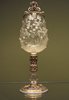
In the Hermitage’s collection of rock crystal, side by side with the works of ancient masters who were the first to achieve heights in artistic refinement of such a hard mineral and the masters of the Middle East, there is a series of artifacts that clearly stand out from the rest. They were made by the European gem cutters in the 16th – 19th centuries. They are numerous and manifold, not only in the quality of the stone but also in the decoration methods and techniques. The Middle Ages are represented by crystal items, hieratic in purpose and intent, such as crosses, reliquaries, lamp stands, in which the mineral often acquired a mystical meaning.
The art of the Early Modern era is represented in the collection of the Hermitage by carved vessels such as cups, goblets, jars and vases which were designed by the major artists of the Renaissance. This epoch is also represented by magnificent intaglios of the Italian gem engravers Valerio Belli and Giovanni Bernardi, the works of which are the pride of our collection. The artworks made of rock crystal were widely common in Italy due to the strong carving tradition and the closeness of the Alps with enormous reserves of this mineral of high quality. The best pieces were chosen by the cutters as the basis of the future artwork. The sides of those vessels were carved so thin that the modern audience will hardly believe that this is stone and not blown glass. In the Hermitage there are excellent artworks made by Milan craftsmen of the 16th century. The two most significant dynasties of the cutters – Miseroni and Saracci – were the pride of carving tradition not only in Italy, but they also contributed to the development of the national art schools. Both the stone and the technique were exported.
In the Hermitage collection one can see exhibits where the stone part is made in one country while the decoration (gold or silver, often with enamels and precious stones) comes from some other European countries. The collections of rock crystals were the pride of the largest European courts, and only the privileged had access to them. Carved vessels were not used for practical purposes as a rule, but they usually served as a decoration of treasuries, cabinets of curiosities or were given as diplomatic gifts. The collection of our museum preserves the objects that belonged to the CardinalAldobrandini, Anne of Clevens, Jan Sobieski, August the Strong, Peter the Grate, Frederick the First, Frederick Wilhelm, etc.
In the 18th century the tradition of the rock crystal artwork in the Western Europe gradually fades away. Rock crystal is being used in the production of the small boxes – the snuffboxes, and the chandelier drops. Rock crystal is replaced by art glass, which is cheaper and easier to work with. But in Russia, where this mineral was first mined and processed in the 18th century, the local gem cutters make interesting works of art: gems, vessels, portable and table stamps. The Faberge artists were the last ones at the turn of the 20th century who worked with rock crystal and breathed a new life into seemingly common objects.